
Changzhou University: enabling “dynamic inheritance” of traditional culture on campus
Recently, Ding Hao, a student from the School of Urban Rail Transit of Changzhou University, held a unique paper-cut exhibition, which attracted the attention of many people. The exhibition, themed on “Chinese Dream • Ideal of the Youth • My University”, changed many people’s impression of male students majoring in engineering, who are usually thought to be dull and stiff. Ding Hao, born in the 1990s, shows his beautiful dream with his exquisite paper-cuts.
Shi Guodong, secretary of the CPC Committee of Changzhou University, believes that the local universities and colleges are important carriers for local cultural inheritance and innovation, as both starting point and terminal of the task. They should integrate all the excellent elements of the local cultural heritage into the process of talent training. That is an objective demand of the economic and social development for education.
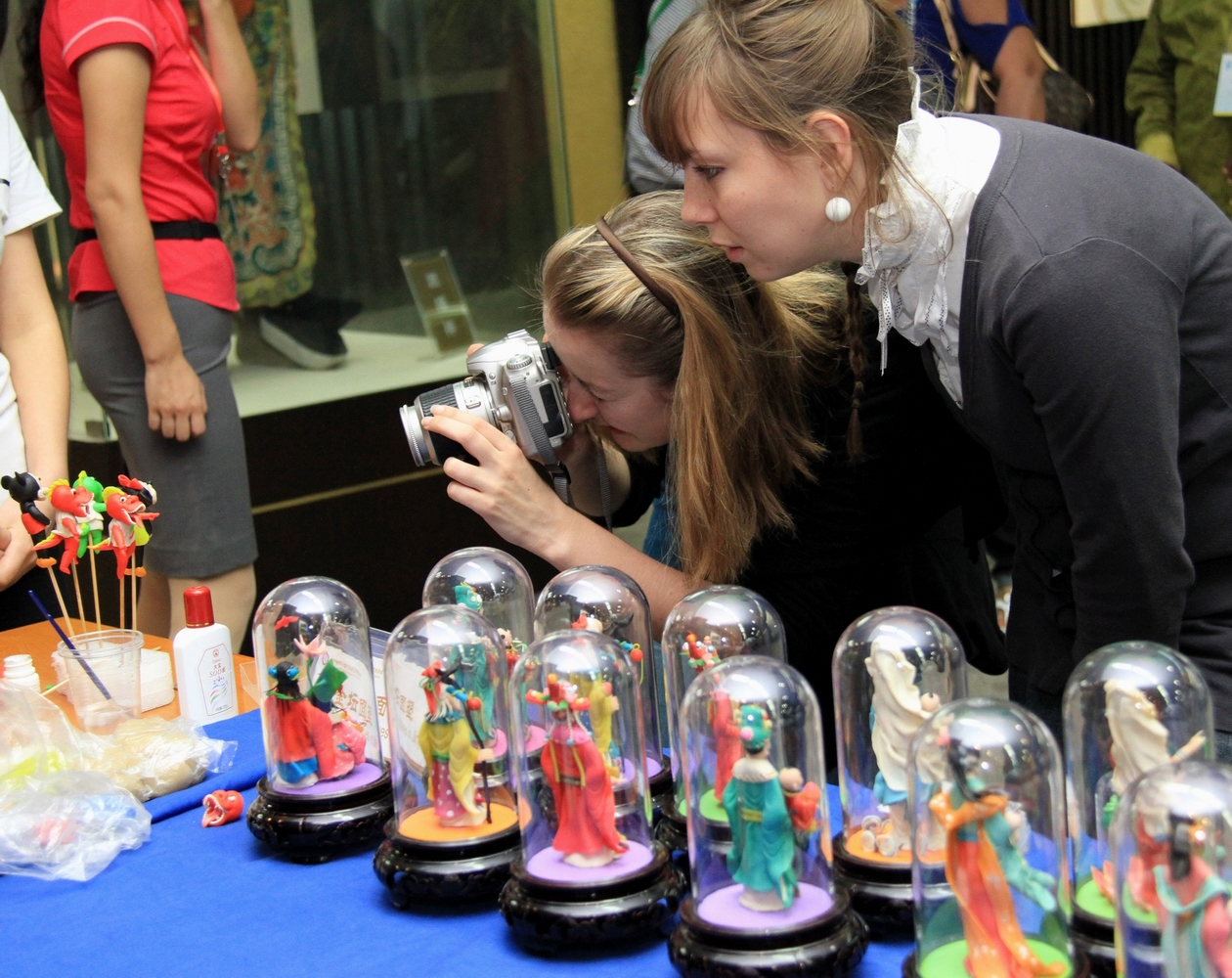
It is one of the characteristics of Changzhou University to integrate the original traditional cultural elements into its classes. In May 2010, Changzhou Intangible Cultural Heritage Exhibition Hall was established in the library of Changzhou University, covering an area of more than 1,000 square meters, with a large number of exhibits. The exhibition hall has become the most authoritative intangible cultural heritage exhibition hall in Changzhou, with exhibits covering Chinese characters, pictures, physical exhibits, sound records and videos. It has received about 100,000 visitors since 2010.
Hu Xueqi, director of Changzhou Local Cultural Research Institute of Changzhou University said that the intangible cultural heritage exhibition hall was established on the campus to recall the memories of the students of the local culture. Hu said, “It is not wise to force the students to be aware of the culture. It is not practicable to promote the traditional culture through administrative measures. What the schools should do is to open the ‘menu’ and then allow the students to choose what they want to eat and how they will eat it.”
In addition to the establishment of the intangible cultural heritage exhibition hall on the campus, Changzhou University has made education about intangible cultural heritage part of the education for freshmen and new teaching and administrative staff. A series of lectures on Changzhou culture have been made optional courses. Experts in local culture have been hired and invited to give lectures. There are also various themed activities.
In the program themed on “inheriting and passing on the family precept, fostering civilized practice”, Yu Yue, student of Class 121 of the Chinese Language and Literature, shared her family precept, “The mind is the master of a person. When the mind is not correct, one cannot act correctly; when one cannot act correctly, he cannot accomplish anything. Therefore it is of great significance for one to cultivate one’s mind.” Yu said, “The mind is the basis of a person. Only with a correct mind can one act correctly and have a right direction and a good attitude.” In her eyes, the family precept, a traditional family virtue of the Chinese nation, is an integral part of the campus cultural construction and one of the socialist core values that students should have.
In light of the characteristics of active thinking and diversified values of students born in the 1990s, Changzhou University has been active in exploring ways to carry out education of socialist core values among the students. Pu Yuzhong, president of Changzhou University, said the common weakness of the core value education at universities is “insufficient atmosphere”. Efforts should be made to infuse the “historical classic” of the traditional culture into the “realistic soil” of the campus culture, actively explore the systematic integration of the “old principles” of the traditional culture and the “new ways” of morality education.
In order to mine the connotation of the traditional culture, Changzhou University has taken measures to enable students to understand the value of “belief” in the process of growth and skill development with the spirits of sages and celebrities as guidance. To this purpose, the university closely combined the programs of reading “books with characters” with “books without characters”, named the roads with the name of “Three Outstanding Personages of Changzhou”, established Hua Lookeng Honors College, Shi Liang School of Law, Zhou Youguang Language and Culture Institute and Tailei Society, and will name Qiubai Class.
While building the “big class” of traditional culture, Changzhou University has actively expanded the traditional cultural practice bases outside the university, mining and using the essence of the traditional culture through multiple channels to enable the socialist core values to root in the students’ minds.
Changzhou University has cooperated with the cultural research institutes to mine the connotation of the traditional culture. In June last year, it established the Research Institute of Filial Piety Culture of Changzhou University; in December last year, the university joined hands with the Presence of IT, Sihai Tongfang Company, and Changzhou Institute of Confucianism to establish Changzhou University Sinology Institute. The Research Institute of History and Culture jointly established with Changzhou Federation of Philosophy and Social Science Circles completed the Brief History of Changzhou Culture of the Qing Dynasty - the first regional dynastic history of Changzhou cultural research, creating a good foundation and resources for the mining and extraction of the modern urban spirit of Changzhou. This book has been listed as the required textbook for students of the Department of Chinese Language and Literature.
Rui Guoqiang, vice president of Changzhou University, said that restructuring of the cultural resources and research on the sustainable development of the Chinese culture gene is the cultural mission that the college education shall bear. By the spirit of innovating the education brand and strengthening the social service functions of higher education institutions, Changzhou University will carry out the socialist core values to nurture the campus culture and inject new fresh blood for the inheritance and passing on of the traditional culture.
In June 2014, Changzhou University was inscribed as one of the first “intangible cultural heritage research bases” of Jiangsu Province. It is learned that the university is planning and designing the online virtual exhibition of “Changzhou intangible cultural heritage exhibition hall” with employment of 3D virtual reality technology and the other technologies so as to build an online intangible heritage exhibition hall with distinct characteristics and create a new channel for students and teachers to receive edification of the traditional culture. (编辑 包海霞)